Some Thoughts on Religion
Are there universal religious beliefs?

“There are no people, however primitive, without religion and magic.”
—Bronislaw Malinowski, Magic, Science and Religion, and Other Essays, 1925
I’ve gotten sick of talking about politics, so let’s talk about something non-controversial. Let’s talk about religion.
Lately I’ve become very interested in the study of religion as a phenomenon. The sheer array and taxonomy of religions is fascinating—it’s like studying some kind of rare, exotic species like birds, or reptiles, or beetles. When you haven’t picked one of the 5500 or so gods worshiped by humanity as the “true” one, it allows you to look at all of them with the eyes of an outsider, which is consistent with the “Martian’s eye view” through which anthropologists try to look at all human behavior.
The variety is fascinating, but, of course, there is the urge to drill down and figure out what, at base, this phenomenon is all about, and why it exists at all. You simply can’t understand what it means to be human without a thorough reckoning with and understanding of the phenomenon of religious belief.
But what, really, is religion? What is at the heart of it? One of the most fascinating aspects of this concept is that it did not exist for most of human history. If you would have went to an ancient Egyptian or and ancient Israelite, or a member of an uncontacted tribe and asked them what their religion was, they would not understand what you were talking about. There was no separation between the activities of normal life and what we call “religious” activities. We tend to separate these behaviors out in modern life, for example, attending religious services in a specific place at a specific time.
What, then defines religion? What are the commonalities underlying this dazzling array of beliefs, practices and behaviors? That’s something I’ve been thinking about a lot. From my—albeit quite limited and circumscribed—knowledge of anthropology, I believe I’ve come up with two mental concepts that form the backbone of all religions, regardless of their outward manifestations. They are:
That there are noncorporeal entities that exist in the world around us that human beings can interact with. We might call these entities supernatural beings.
That this conscious reality is not the only one, but rather there is (at least one) parallel, or alternative reality.
As far as I can tell, these are basic commonalities shared by every supernatural belief system on earth, from small tribes living in the rain forest (like the Pirahã or the Mbuti), to tribal peoples like the Germanic Tribes or Plain Indians, to massive civilizations like Han China and ancient Greece and Rome, to modern-day religions like Islam, Hinduism and Christianity.
Once we have that basis, we can start adding to it, like adding ingredients to the broth base of a soup. Let’s take a closer look at this “religion soup.” Beyond these two common beliefs, we can define two other characteristics that seem to be shared among religions:
1. They all seem to involve means of asserting some modicum of control over random or unpredictable events. By this I mean things like the weather, hunting success, warding off diseases and other misfortunes, and ensuring a favorable outcome.
This can be seen in practices like divination, which seems to be a near-universal practice. This might be an outcome of hunting. I seem to recall reading somewhere that hunters would randomize their actions by rolling knuckle bones as dice. This randomness would prevent prey from being able to predict the hunters’ behavior based on past actions. Another example would be apotropaic magic, which is designed to ward off evil.
2. As a means of coping with our mortality—the fact that we’re all going to die. As the only creature with sufficient frontal lobe capacity to truly comprehend this fact, we are the only creature that can be haunted by it in a way other animals cannot be.
There is, of course, an entire branch of psychology known as “terror management theory” that seeks to explain much of human behavior through this lens. This field is based on Ernest Becker’s highly influential work, The Denial of Death, where he argues that unconscious death anxiety is behind a wide range of behaviors, from works of art, to monumental architecture, to empire-building in politics and business. Every religion copes with human mortality in some way, although, it’s important to note that the cushy, blissful afterlife promised in today’s monotheistic religions is an outlier. This idea was absent even from ancient Judaism which give rise to the major monotheistic religions. However, most religions had some notion of the continuation of consciousness past the point of death in some form. But how, and in what state that consciousness existed, varied greatly.
Since I include supernatural elements as part of my definition of religion, this allows me to know what to include and what to exclude. Any definition is arbitrary to some degree, and this allows us to break off religion from all those other human passions that often get lumped into the “religion” category like politics and sports fandom. Passion, shared rituals, and group membership are important human phenomena, but calling all this stuff “religion” whenever we encounter it makes the word lose all meaning.
This also allows me to arbitrarily distinguish between what is considered “religion” and what is “philosophy.” I argue that, if it does not possess the two fundamental characteristics described above, then it is not a religion by my definition. Take, for example, the perennial debate over whether Buddhism is a religion or a philosophy. Which is it?
Well, as it’s actually practiced, it’s clearly a religion. Anyone who has looked at how Buddhism is actually practiced day-to-day in Asian cultures knows that Buddhists believe in a wide variety of supernatural beings—Tibetan Buddhism is a particularly colorful example of this. But it is possible to follow Buddhist practice without having any supernatural beliefs, and many Western gurus advocate exactly that approach. In that case, I would call Buddhism a philosophy, similar to Epicureanism, Stoicism or Cynicism. The Greek culture which gave us those philosophies made a stronger distinction between religion and philosophy—a distinction more blurry in Dharmic religions like Hinduism or Buddhism.
Naïve Physics
Now, let’s talk a little more about those two basic elements. Where did they come from?
As I see it, they make total sense given the information people had at the time. Let me explain.
Let’s take the first item—the existence of supernatural beings. This is often considered to be a result of Hyperactive Agency Detection (HaAD). This is the idea that we are hard-wired to presume things are caused by some sort of conscious actor, rather than just random events with no cause. This is supposedly evolutionarily advantageous as means of escaping predators.
A more simple explanation is this: since we know that we can have bodies without minds (which is the definition of death), it stands to reason that we can also have minds without bodies.
I have a large flock of doves that I feed on my balcony. Every once and a while, as I’m walking around the neighborhood, I’ll see a dead dove lying on ground. The dead dove looks exactly like the living ones gobbling seeds at my bird feeding trough, except, of course, that it’s dead. But why is it dead? What is the difference between the living and dead doves? Surely, there must be some kind of “force” there. As a wise person once noted, the amount of cells in a living and a dead body are exactly the same. So, it makes sense to conclude that the difference cannot be anything physical. Rather, it must be something nonphysical, or metaphysical. Even today defining exactly what is “alive” and what is not is surprisingly difficult.
Surely ancient people must have thought deeply about the same questions as I do on my walks. Ancient humans were hunters who killed animals for a living. The two things that are obvious when an animal is killed are that the heart stops beating and it stops breathing, When an elderly animal of any sort dies—including humans—without any signs of obvious trauma, they simply cease to breathe.
Which is why many ancient cultures made a connection between life and breath. The ancient Israelites believed that breath entered the body and gave life—God breathes life into Adam, the first man, and breathes life into newborn infants. When a person dies, the breath leaves the body. Ancient Israelites believed that the final exhale was the soul leaving the body. The ancient Greek word for “breath” was the same as that used for “soul.”
More pointedly, we now know that there actually are invisible lifeforms all around us that have agency and seek to do us harm. We call them pathogens—bacteria, viruses, parasites, fungi, and other microorganisms. They are invisible because we cannot see them with the naked eye unaided, and, of course, neither could ancient people. And these life forms have agency in the sense that they want to survive and produce, just like any macroorganism. So there really are invisible life forms all around us—we just conceptualize them differently because we have the tools to see them directly.
So, I would argue, many of these ideas make “sense” from a pre-scientific viewpoint, whether or not you accept the HaAD hypothesis (and I have my doubts).
As for the alternative reality, we all know that this exists because we experience it every night. It’s called dreaming!
Think of how ancient people would have experienced dreaming. Every night, they would be transported to another world where what has been called “dream logic” prevails. In that world, you can die and come back to life, or see and talk to people who have previously died. Reality appears different than in the waking world—more malleable and less rational. No wonder you would believe in an alternative world! Note how many of the world’s myths, legends and stories seem to feature this dream logic. This article defines dream logic as:
The nonsensical logic one possesses while dreaming that makes perfect sense until he or she wakes up and,
Information one magically/automatically possesses in a dream without having learned it before.
With our modern sensibilities, we see these experiences as being entirely self-generated by our own consciousness, or, rather, our unconscious mind, and assign them to the “fake,” or “not real” category. We claim they are just hallucinations generated by the three pounds of jellied oatmeal inside our skull cavity. But how would ancient people have known this? What would have made them come to that conclusion? They may have observed that the body didn’t move while someone was dreaming, but this only would have reinforced the belief that they must have been transported to another world during the dream.
Not to be too gross, but, as hunters and butchers of mammals, ancient peoples would have been intimately familiar with the vital organs. They surely would have noticed that the brain had a very dissimilar texture and consistency than all the other organs of the body. But it’s not immediately obvious that this is where the seat of consciousness lies. Why would it be? Unlike the heart and lungs, nothing observable physically happens to the brain when the body dies. That’s different than the heart, for example, which may be why ancient people identified the heart as the seat of the soul. Due to its central location in the chest cavity and pumping action, it was assumed to animate living things while it was speculated that the brain was nothing more than an organ for cooling. We still talk like this today—we talk about feelings coming from “the heart” rather than our brain; e.g. “home is where the heart is,” and similar terms such as “heartache.”
It was thought that if the “alternate” reality experienced in dreams could be accessed while awake, you might be able to accomplish things you could not in “normal” life. You could acquire information that you would not have access to, just like in the dream where you know things that you have not experienced directly. You might be able to see or transport yourself to far off-places. You might be able to communicate with supernatural entities, or even the dead (i.e. necromancy). And you might be able to control the weather or predict the future.
This is the idea behind shamanism. Shamans are members of the tribe who demonstrate an ability to go into a trance allowing them to explore this “alternative” reality during waking life. And not just anyone can access these trance states. It’s an innate ability, and often certain people are chosen, as Corine Sombrun discovered.
Another way to say this is that ancient people interpreted all of their sensory experiences as “real,” whereas we moderns make a sharp distinction between the “real” and the “unreal.” But, if you think about, this is hardly an intuitive point of view. Rather, it is a product of our materialist world view, which most ancient people did not share. It’s not at all a “natural” way to think about the world unless you are taught it culturally, as we are. For us, it is simply the water in which we swim which makes it harder to understand how ancient people experienced the world around them.
So you can see why the lived experience of ancient people would have caused them to believe in tings like invisible agents and alternate worlds. This is why early anthropologists argued that animism (a belief in noncorporeal spirits and a living world) and shamanism were the “primordial” religious belief systems out of which all subsequent religions sprang. This idea has fallen out of favor as “universalist” explanations have been treated with suspicion by modern anthropology. But I think there may be something to them and we may have rushed to throw out good ideas with bad.
Other religious beliefs also seem to stem from an intuitive sense. In many cultures, the dead were often said to dwell somewhere beneath the earth. This place was referred to as the underworld and, unlike today’s comfortable afterlife, it was not presumed to be pleasant. This makes intuitive sense, since we bury the dead in the earth, and bodies eventually decompose to become compost. Meanwhile, the sky above was considered the dwelling place of the gods, or else other high places like mountains. These were ouranic, or celestial deities, as opposed to chthonic ones which dwelt beneath the earth. Even today in Christianity, we instinctively go “down” to hell and see heaven in the clouds above us, despite the fact that astronomy clearly shows this is impossible (did Jesus ascend into the troposphere and keep going?). In many shamanic religions, trees were sacred, as their roots penetrated under the earth and their branches reached up toward the heavens, uniting the multiple worlds (as in the Norse World Tree, Yggdrasil).

Two other very common (although not universal) religious practices should be mentioned. One is ancestor worship or ancestral veneration. This is the idea that one’s parents, grandparents, great-grandparents, and so on, do not die, but continue to live on in some form, and that they have some sort of special knowledge or influence over events in the physical world. As a result, in these cultures, ancestors were continually venerated after they died. I’ve previously argued for a link between ancestor worship, the emergence of social hierarchy and military expansionism. Ancestor worship is extremely common in cultures all over the world.
The other is sacrifice—the ritual slaughter of an animal and offering its flesh to the gods. This practice seems to have been almost universal, as we noted when we looked at Barbara Ehrenreich’s book, Blood Rites. It’s difficult to find a culture anywhere on earth that did not practice animal sacrifice, or some related kind of ritual bloodletting, and this surely cannot have been transmitted merely through cultural influence. There must be something inherent in it. Sacrifice was seen as an exchange between men and gods—one sacrificed if one wanted something from the gods, and the more valuable the sacrifice the greater the favor asked. After the animal was slaughtered, its entrails were typically examined to discern the future, a practice known as extispicy. These practices probably stem in some way from our time as hunting animals.

To be clear, I do not think any of these things explain the origin of religion itself as Edward Burnett Tylor hypothesized. But it might explain some of the forms religion took in cultures around the world. These were based off of empirical observations and the lived experiences of people themselves in an age before scientific inquiry.
I think the overwhelming amount of empirical evidence indicates that religion evolved for a social purpose. That is, it could only evolve in a social animals like ourselves, and not, for instance, in solitary animals like tigers or sloths. It’s a misapplication of our evolved social intelligence, what evolutionary biologists call an exaption. That’s something which evolved for one purpose, but became “hijacked” to serve another purpose for which it did not expressly evolve. Feathers originally evolved for warmth, but became useful for flight.
A related concept is a spandrel. A spandrel is the space between arches. No one ever sets out to build a spandrel—they set out to build an arched colonnade. However, by creating the arched colonnade, spandrels are automatically formed in the space between them, whether you want them to be or not. The builders of Saint Mark’s Cathedral in Venice decided to elaborately decorate their spandrels to give them their own unique character. This is analogous to traits which were not selected for directly, but rather emerged as “side effects” of others which were.
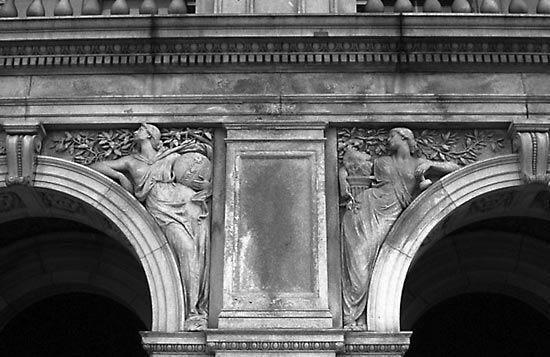
Whether religion is a spandrel or an exaption, it allowed for more cohesive groups to form which likely outcompeted other groups in the very distant past. It allowed us to bypass bounded rationality and cooperate on a larger scale and in more dispersed groups than other species, perhaps even our own close relatives. This is why it persists today, even in our materialistic, scientific world when we’ve come up with rational explanations to a lot of the mysteries which vexed our ancestors. It’s worth noting, however, that places with good, functioning institutions and a high degree of social trust and cohesion tend to be less religious, although whether that’s an effect or a cause remains to be seen.
Fact-check: the Mbuti live in a part of the Congo rainforest region, not the Amazon rainforest.
What, spanking children wasn't on the menu?
(I swear corporal punishment brings out the worst in comment threads)